01
EPDM, TPO or modified bitumen
Rubber is forgiving on awkward shapes, TPO welds its seams so they become the strongest part, and modified bitumen takes the foot traffic of servicing a unit.
Serving the Miami Valley
Roof Replacement
TPO, EPDM and modified bitumen over garages, extensions and porch roofs. Where the slope is wrong, that gets fixed before anything is covered.
Tell us whether water pools up there. If it does, the slope gets fixed before anything is covered.
Fall corrected first
A new membrane on a deck that ponds is the old problem wearing a newer surface.
Wet insulation removed
Water trapped in the layers cannot be roofed over. It comes off, and you see exactly why.
Deck checked underneath
On older garages we regularly find roof boards that have been quietly flexing for years.
The Problem
No. It gets you the same problem with a newer surface on top of it.
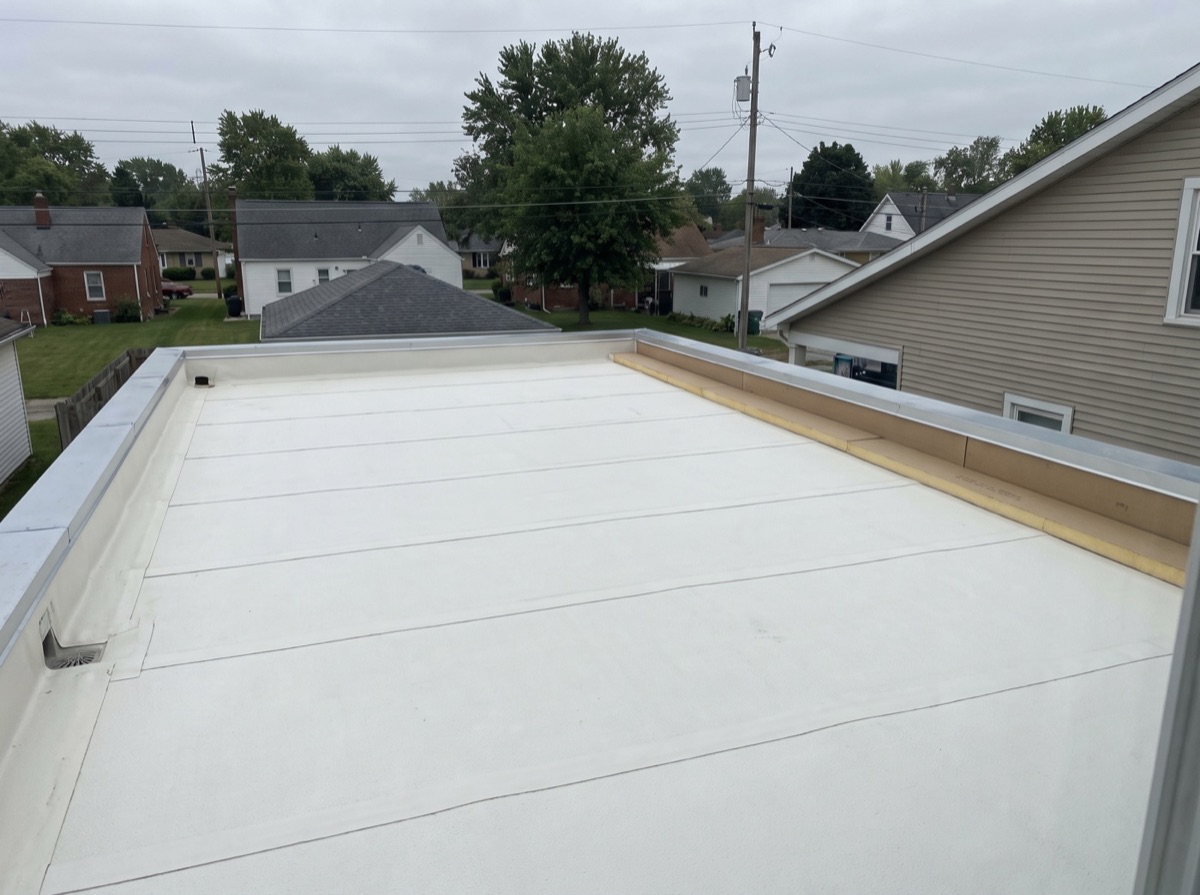
Every low-slope roof has a fall built into it, usually about a quarter-inch per foot, because standing water is what kills membrane. So most of the thinking in a flat roof replacement goes into where the water is meant to go rather than what covers it. Twenty-three inches of snow across a season sits there until it melts, because a flat roof cannot shed any of it. That is why we look at the wood and the structure underneath, not just the covering.
Why Us
Get the fall and the outlet right and the material becomes a straightforward choice between three good options. Get it wrong and none of the three will last.
Rubber is forgiving on awkward shapes, TPO welds its seams so they become the strongest part, and modified bitumen takes the foot traffic of servicing a unit.
Water trapped in the layers under an old membrane cannot be roofed over. It is the one discovery that reliably moves the price.
A pitched roof sheds; a flat roof holds everything until it melts. On older garages we regularly find a deck that has been quietly flexing for years.
What We Do
Everything we cover under Dayton roofing services, from a single slipped shingle to a full tear-off. Not sure which one you need? Call and we'll tell you straight.
The Difference
People call us asking for TPO or rubber, and the material is genuinely the least important part of a flat roof replacement. What determines whether it lasts twenty years or five is where the water goes. That means the slope built into the roof, where the outlet sits, and whether anything is trapped in the layers underneath.
Get those right and all three of the common materials perform well. Get them wrong and none of them will, whichever one is written on the quote you signed.
Plenty of these are garage and porch roofs on the ranches around Kettering, where a shallow roof was never going to shed much.
How It Works
Strip, assess, build the fall, then cover it.
Insulation included, because that is where trapped water hides and it has to be seen to be judged.
Soft or flexing boards replaced now. Nothing new goes over something that is already moving.
Tapered insulation where the existing fall is wrong, so water actually reaches the outlet.
Seams heat-welded on TPO or bonded on rubber, then flooded and checked before we leave.
Reviews
“We had a leak over the back bedroom for almost two years and kept putting a bucket under it. The team found the problem in about ten minutes. It turned out to be the flashing around the chimney, not the shingles. They fixed it that same afternoon. I wish we had called sooner.”
“We had a full tear-off on our 1950s ranch. The crew arrived at 7 every morning and finished the job in three days. They even swept the entire driveway with a magnetic roller so our kids wouldn't pick up any nails. The final price was exactly what we were quoted.”
“After the hail last June, our insurance company questioned whether the damage was from the storm or simply the age of the roof. The team inspected everything, took detailed photos, and joined the call with our adjuster. The claim was approved. I don't think we would have managed it on our own.”
“Good work at a fair price. I gave four stars because our job had to be pushed back a week due to rain, and I had already taken the day off. They did call ahead and kept us informed instead of simply not showing up, which I appreciated.”
“A tree came down on our garage roof at around nine at night. Someone actually answered the phone, which I wasn't expecting. They had the roof tarped before midnight and came back the following week for the permanent repair. Great response when we needed help.”
“We had new seamless gutters and gutter guards installed around the whole house. They made the gutters right there on site, which I hadn't seen before. We've had two heavy storms since the installation and nothing has overflowed onto the patio. That was exactly the problem we wanted fixed.”
“I booked a roof inspection expecting to hear that we needed a full replacement because that's what the previous two companies told us. After inspecting it, they said our roof probably had about five years left and told us to call back when the time came. They didn't charge us for the inspection. That honesty is why they'll get the job when we eventually replace it.”
“This is the second time we've used them. They installed our gutters a couple of years ago, and we recently hired them again for a full roof replacement. We even had the same crew leader both times. The quote was clearly itemized, so we could see exactly what we were paying for, including the wood underneath repairs.”
Every flat roof is built with a slight slope, usually about a quarter of an inch per foot. A truly level roof holds water, and standing water is what destroys the rubber or plastic covering on top. When we replace one, most of the thinking goes into where the water is meant to go rather than what the surface is covered with. If the existing roof ponds, putting a new membrane on the same deck buys you the same problem with a newer surface.
Forty-one inches of rain and twenty-three inches of snow a year, sitting on something that cannot shed any of it, is a much harder test than the same weather on a sloped roof. That is why the flat sections on Dayton houses, garages, porch roofs, 1960s extensions, often need replacing while the main roof is fine. If yours is patchable, flat roof repair covers when that is the better answer.
Three materials cover almost all residential low-slope work, and the choice is mostly about size and access rather than preference.
A single sheet of black synthetic rubber, adhered down. Forgiving of an awkward shape, twenty to twenty-five years, and the least expensive of the three on a small garage roof. Black, so it absorbs heat, less of a drawback in Ohio than it would be further south.
A white welded thermoplastic. The seams are heat-welded rather than glued, which makes them the strongest part of the roof instead of the weakest, and the white surface reflects heat. It is what we fit most on anything larger than a garage.
Asphalt sheet in two layers, torched or self-adhered. Tough underfoot, which matters on a roof somebody walks on to service an air conditioner, and it patches easily years later.
Twenty-three inches of snow across a season does not sound like much until it arrives as one storm and sits on a roof that cannot shed any of it. A pitched roof sheds; a flat roof holds everything until it melts, and wet snow is heavy.
So when we replace one, we look at the deck and the structure underneath rather than just the covering. On the older garages around here we fairly regularly find a deck that has been quietly flexing for years. Better to know that before the membrane goes on than after.
Flat roofs are priced by area, and per square foot they cost less than a sloped replacement. There are no old layers to strip, no scaffolding for a steep slope, and the area is usually much smaller. Three things move the number. How many vents and pipes come through it. Whether insulation is being added to build the slope. And what the wood turns out to be like once the old covering is off. Fifteen to twenty-five years is the realistic life on a low-slope roof in this climate, which the lifespan guide sets out alongside the others.
The one discovery that reliably makes it expensive is wet insulation. Water trapped in the layers under an old covering has to come off, because you cannot roof over it. That is a disposal cost as well as a labor one. Ohio requires a permit for the work at $75 to $500, and we pull it. For the pitched side of the comparison, see the pitched-roof version and the cost guide.
Per square foot, yes, usually meaningfully cheaper than a pitched replacement, because there is no stripping of several old layers and no scaffolding for a steep slope. Per house, it depends entirely on how much of your roof is flat. A garage roof is a small job; a whole flat-roofed extension is not.
We price by area, by how many pipes and vents come through, and by what the wood turns out to be like. We will not quote it over the phone, because nobody can see the wood from the driveway. For scale: a full pitched replacement in this area runs $8,500 to $18,000, and a typical residential flat section is a fraction of that.
If all 2,200 square feet is genuinely flat, that is commercial-scale work rather than a house. On a Dayton home, the flat portion is usually a few hundred square feet over a garage or extension. For comparison, a 2,200 square foot architectural shingle replacement here runs $13,500 to $18,500.
The guideline carriers and building officials use to decide repair against replacement: past roughly a quarter of the roof, patching costs nearly as much and lasts less. On a flat roof it arrives sooner than on a pitched one, because the failure is usually the whole surface aging at once rather than one damaged spot.
Free Estimate
The slope and the outlet decide whether it lasts twenty years or five. The covering matters far less.